
Finding Rome Residents
A useful Rome residents directory search starts with the kind of fact being checked. A current parcel question belongs with the assessor and the county roll. A recorded ownership question belongs with the Oneida County Clerk. A dated household question may belong in a directory, newspaper, or library collection instead. Rome is in Oneida County, but its city offices and the County Clerk in Utica keep different parts of the trail. That split is often the reason a search succeeds or stalls.
Use a result as a dated record lead, not a conclusion about a person. An owner field, a mailing address, an old directory listing, a court docket, and a license verification answer different questions. The safest order is to match the source to the date and purpose, preserve the record date, and confirm an important finding with the office that holds the original.
- Start with the address, name, or date already known and choose the matching Rome or Oneida custodian.
- For a property lead, compare the assessor record, annual tax roll, and county parcel map before following names.
- Use the County Clerk’s recorded-instrument index for deeds, mortgages, maps, and other party-based filings.
- For an older household, check a city directory edition and then test the listing against a deed, roll, newspaper, or map.
- When no online index fits, use the counter, a narrow records request, or the library and archive route.
Note: Rome has no official citywide municipal resident roll, so each source should be read for its own limited purpose.
Rome Resident Record Custodians
Three offices form the practical core of Rome resident research. The City Assessor connects a property to its assessment and inventory. The Oneida County Clerk records deeds and many county series. New York’s voter tool has a much narrower role, helping a registered voter check registration and poll-site details rather than publishing a general directory. The City Clerk, courts, libraries, and State agencies take over for records outside those lanes.
The address on a Rome record does not decide custody by itself. A city-held vital event is handled by the local registrar, while recorded land instruments are held in Utica. The cards below identify the most common starting points. For a full street-by-street parcel chain, use the Rome street directory route rather than treating a single portal as complete.
Rome City Assessor
198 N. Washington Street
Rome, NY 13440
(315) 339-7614
New York Elections
Statewide registered-voter tool
Choose Oneida County
Use the official lookup
Rome Parcel Records
Rome’s property trail has three layers that should be compared, not merged. The City’s Image Mate access point describes assessments, ownership and mailing fields, lot size, building square footage, and property inventory. Oneida County’s annual rolls preserve a roll-year snapshot. The county’s interactive map adds parcel geography, including owner, address, assessed value, acreage, and overlays such as school districts, floodplains, sewers, wetlands, soils, and contours.
Use the parcel or tax-map key as the bridge. A printed street form can change, and a mailing address can be elsewhere, but a PIN identifies the assessment unit. The 2024 through 2026 county roll archive provides dated comparison points. A tax roll can show a printed owner field and deed book/page reference, but it does not prove occupancy on every day of the roll year.
| Rome property field | How it helps |
|---|---|
| Owner name | A starting name for a recorded-instrument search. |
| Situs address | The physical property address to compare with GIS and USPS. |
| Parcel ID or tax-map number | The stable key for rolls, maps, and deed research. |
| Lot and building inventory | Property characteristics, not a resident roster. |
The Rome Image Mate property portal is the public property-information entry point.
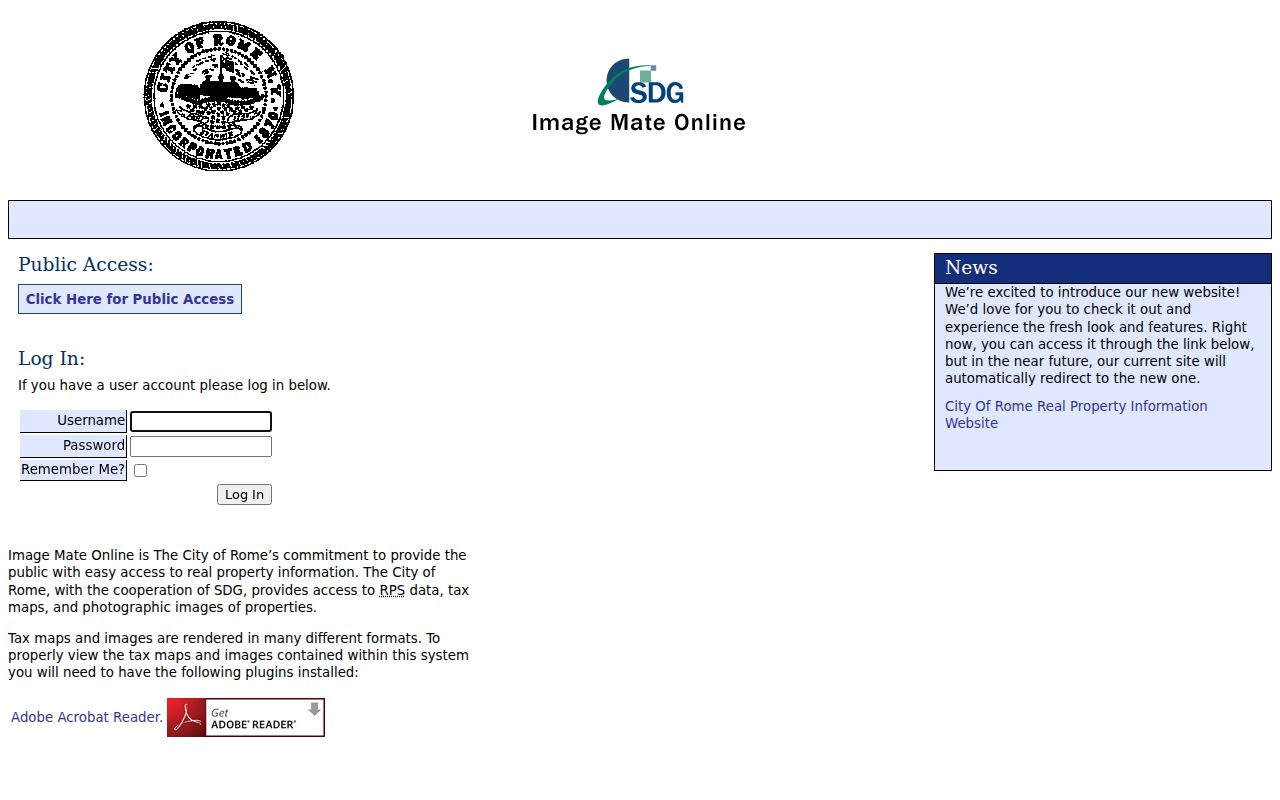
That public screen is a first check for a parcel, followed by the dated tax roll and a deed or certified record when ownership precision matters.
Rome Names in County Indexes
The County Clerk’s SearchIQS system is a party-and-instrument index, not an address directory. Enter names last name first without punctuation, then use a wildcard, date range, document group, town, book/page, instrument number, or case number when the record supports it. Town is optional because not every document is indexed to town. For a Rome parcel question, first gather the current and prior owner names from the property layers, then search grantor and grantee names.
Coverage matters. The public-record legend lists deeds from 1963, with data-only coverage through 1974 and index/image coverage generally from 1974 forward. Mortgages begin in 1963 with images from 1973. A blank result may reflect a different record series, a spelling form, index-only material, an excluded document, or a record kept by another office. Guest searching is free, while image and copy access may carry a charge.
The Oneida County public-records page leads to the County’s search and in-office options.
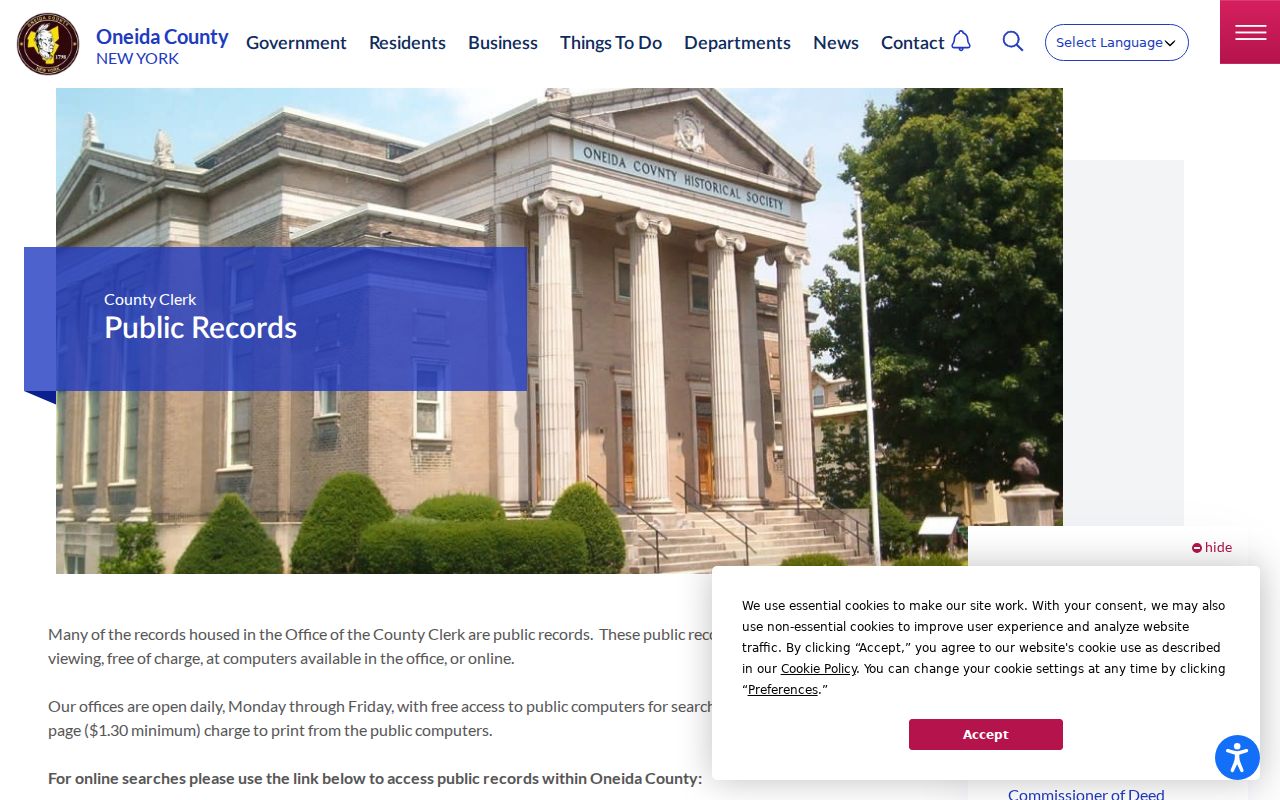
When an online result is incomplete, the County’s public computers and archival books provide a free in-person fallback before a copy is ordered.
Current Rome Resident Sources
Current records form a patchwork rather than a single Rome residents directory. Each row below has a different subject, update cycle, and access route. A record owner, a party to a deed, a public official, and an authorized voter lookup result should not be treated as interchangeable evidence about a household.
| Rome source | What it can confirm | Custodian | Access path |
|---|---|---|---|
| Image Mate and tax rolls | Assessment, parcel, printed owner and mailing fields | Rome Assessor / Oneida County | Portal and annual PDFs |
| SearchIQS | Parties to recorded instruments | Oneida County Clerk | Free guest search, copies may charge |
| Voter Lookup | A registered voter’s own status and poll site | New York State | Authorized lookup only |
| City licenses and proceedings | Dated city administrative activity | Rome City Clerk | Office or City FOIL |
| Professional verification | License status and professional role | New York State | Profession or license search |
Use the source that fits the question. A name that needs confirmation across official records can move to the Rome resident lookup workflow, while an address history needs a separate parcel and deed sequence.
Rome Voter Record Limits
New York’s public Voter Lookup is built for a registered voter’s registration and poll-site information. Its visible inputs include first name, last name, date of birth, county, and an optional ZIP narrowing field, with address fields presented dynamically. It is not an open list of Rome residents. An individual voter file requires a written FOIL request and an elections-purpose statement under Election Law §3-103(5).
For public election research, the newer Flateau Voting and Elections Database supplies aggregate results, poll sites, district maps, and statistics for covered elections while excluding individual voter records. Rome’s seven ward maps and public meeting materials are useful civic geography, but they do not identify private households. Use the smallest record and date range needed for a lawful civic question.
The New York voter lookup shows the official registration-search surface.
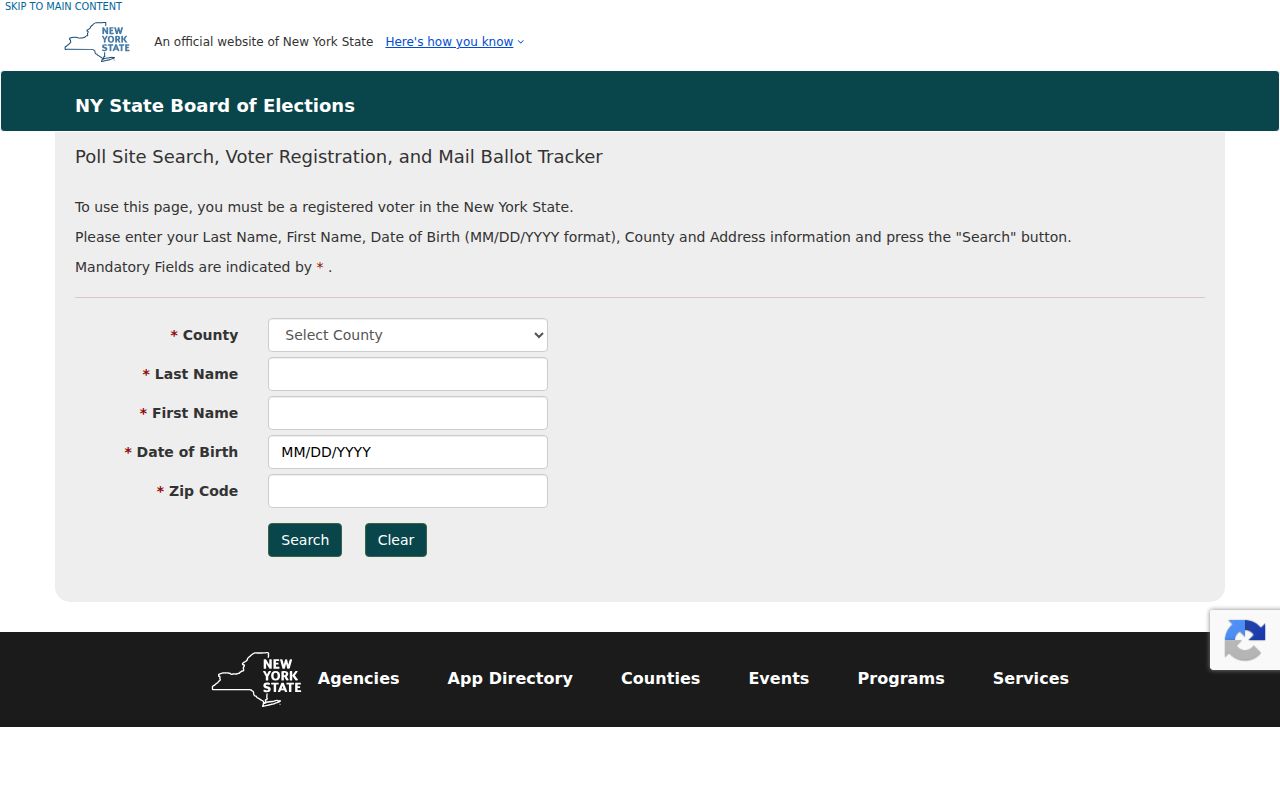
The form’s purpose and the statutory request route are important limits, even when a name and ZIP seem to match.
Rome City Records by Request
The Rome City Clerk holds city records such as Common Council proceedings, City Code and Charter material, licenses, and local vital-statistics functions. Code Enforcement is a second city route for permits and inspections. No official public online permit index was located, so an address-based history needs a narrow request to Code Enforcement or a City FOIL request that names the parcel, record type, and date range.
City FOIL is only for City-held existing records. The form accepts requester contact information, record type, a description or date range, and a choice between copies and inspection. The City says it does not need to create a new record or answer a broad question. Birth, death, and marriage certificates follow local registrar and State Department of Health rules rather than a County Clerk or ordinary FOIL route.
The Rome department directory identifies the offices that route local questions.
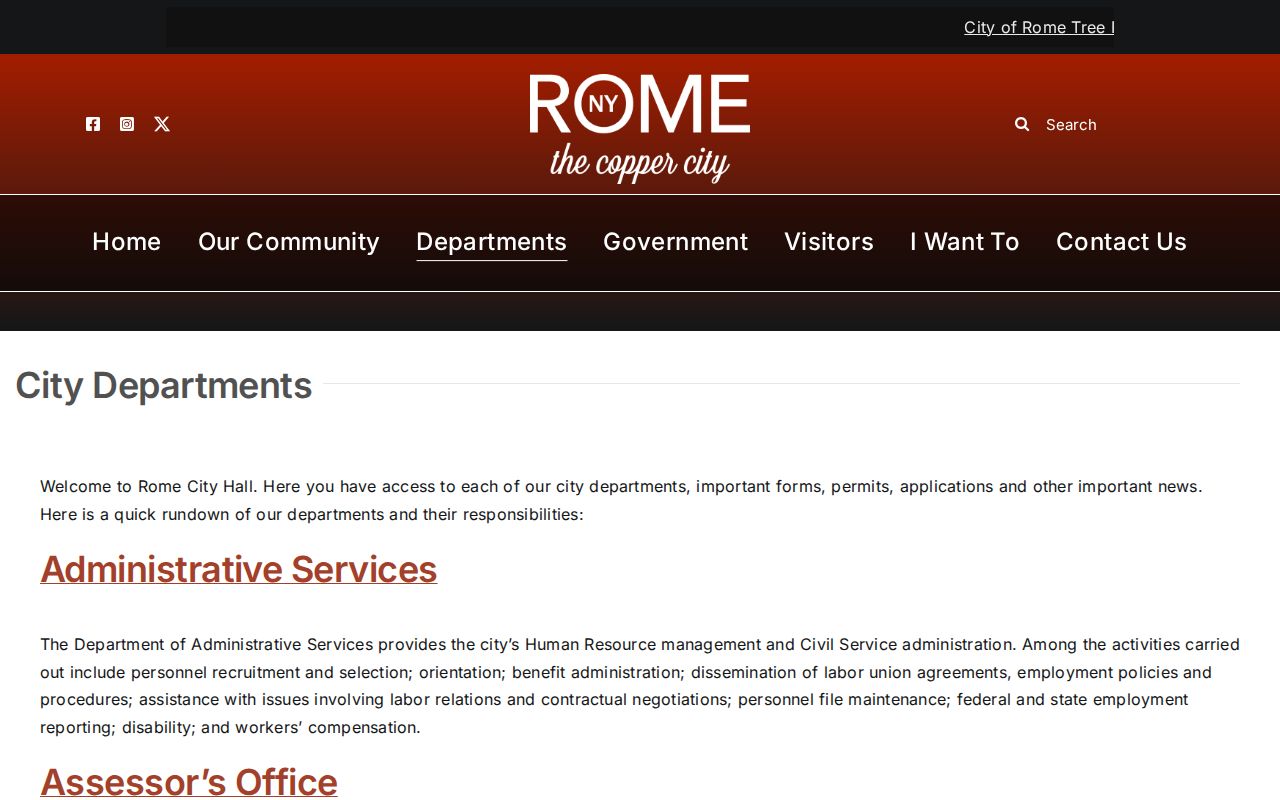
Starting with the correct City office makes a specific request more useful and avoids asking one custodian for another custodian’s series.
Rome Court and Vital Trails
A one-name search can lead to several systems. NYSCEF offers guest searching for civil filings through case identifier and name routes, with county, case type, and paired filing-date filters. WebCriminal is limited to selected courts and future appearances, not a complete historical criminal index. Rome City Court and the appropriate court clerk are the fallback when a portal does not show a needed public series. Sealed and confidential matters stay outside ordinary searching.
For a Rome birth, death, or marriage, begin with the Rome City Clerk when the event occurred in the city. The local registrar route is separate from the County Clerk, and genealogical copies of older city certificates are non-certified. State eligibility is strict: New York’s genealogy framework generally uses 75 years for a birth when the person is known deceased, 50 years for a marriage when both spouses are known deceased, and 50 years for a death. Vital records are not ordinary FOIL records.
- Docket
- A court’s case-event record, which is not necessarily the complete file or final outcome.
- Index image
- A searchable entry or scan that may point to a record without being a certified copy.
- Certified copy
- A custodian-issued copy that can have different eligibility and fee rules.
Rome Historical Directory Years
Rome’s historical directories are dated snapshots, not modern identity files. The New York State Library documents Rome holdings for 1857/58 and 1859/60 on fiche, 1866/67 on film, and an 1871/72 Utica/Rome Area directory on film. The 1934 Rome directory scan preserves printed names, addresses, household shorthand, and occupation clues. Read the page image rather than trusting OCR alone, then compare a listing with a roll, deed, newspaper, cemetery source, or map.
Jervis Public Library and the Rome Historical Society extend the shelf with local-history leads, yearbooks, cemetery resources, papers, photographs, maps, and research help. A directory line can support phrasing such as “listed at this address in this year.” It cannot prove a person owned the property, lived there continuously, or remains there now. The full collection-by-collection route is on the Rome city directory page.
Rome License Verification
Professional verification can clarify a public role without becoming a residence claim. New York’s Office of the Professions lets a user select a profession and enter at least three surname letters, usually as last name then first name, or use a full six-digit license number. Results can show a licensee name, profession, number, location, original-license date, registration status, and discipline summaries since 1994. Punctuation variants can matter for names with apostrophes or prefixes.
A professional result does not establish that a person is a Rome resident. It is best used to verify the role attached to an already relevant public filing, family record, or business contact. The Department of State entity search and City Clerk license files have their own separate purpose and update cycle.
The New York professional verification search is the official starting point.
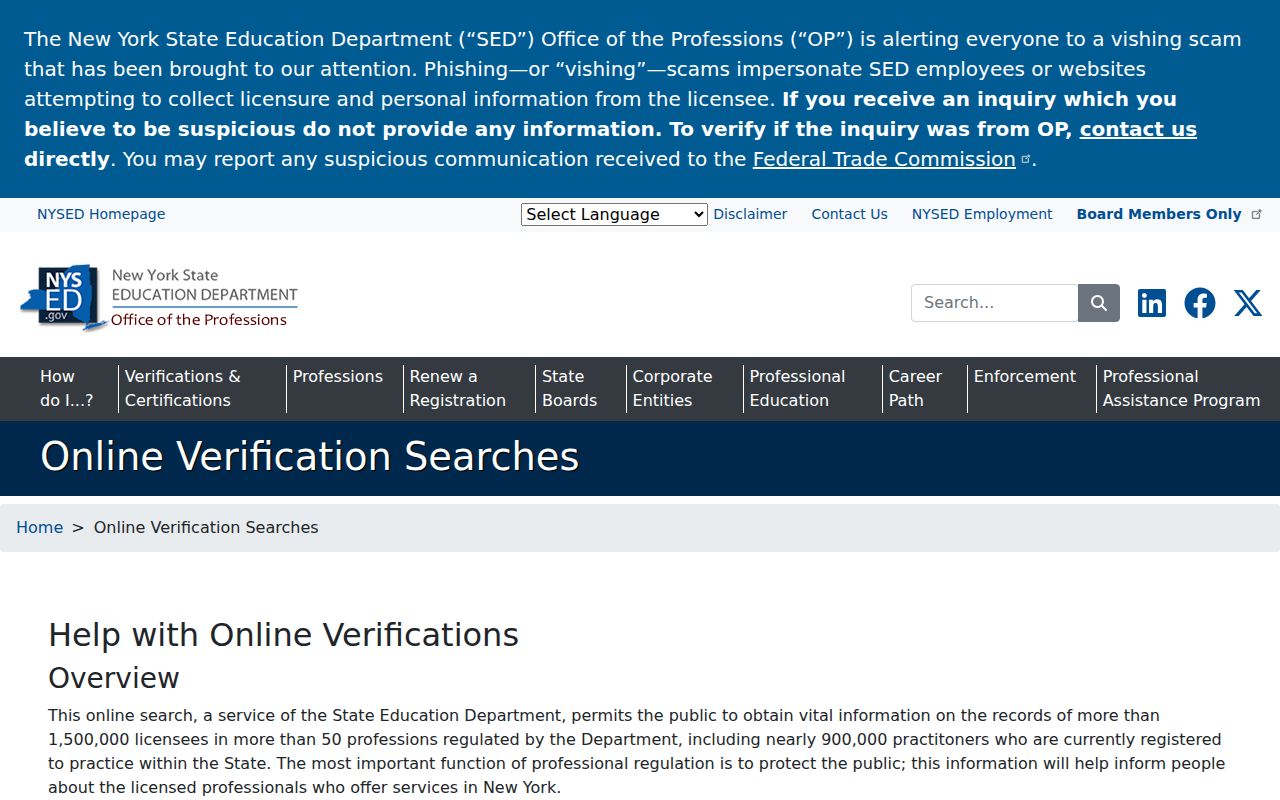
Use its status and profession fields as a verification detail, then retain the source date with the note.
Rome Records Gap Story
Rome’s paper trail has a local reason for gaps. A Rome courthouse opened in 1808, another opened in 1847, and the courthouse and jail were destroyed by fire in March 1848. A replacement opened in 1851. That history does not prove that every early record vanished, but it does mean a missing early court or administrative file should be treated carefully rather than filled with a guess.
For an early Rome question, substitute sources can include surviving deeds, naturalization material, newspapers, the County Clerk’s Regional Records Center, local-library holdings, and the Rome Historical Society. State Library newspaper runs have gaps of their own. A good historical note identifies the series searched, its dates, and the custodian, then says what was not located in that source.
Rome Privacy Boundaries
Public access is not permission to assemble a private profile. New York’s Address Confidentiality Program provides a substitute mailing address for eligible participants, and confidential voter registration protects actual residence information. Court, adoption, juvenile, vital, and driver information have additional access restrictions. A substitute address must remain a substitute address, not a clue to reverse-engineer.
Match similar names only after confirming independent, non-sensitive details with the custodian. Do not publish dates of birth, certificate images, live custody information, or unnecessary phone numbers. The record’s date and source are often more useful than a broad claim about a person.
Rome Search and Copy Costs
Access is not one price or one channel. Oneida County says public computers and archival books can be searched free in person, while printing from those computers costs 65 cents per page with a $1.30 minimum. SearchIQS guest searching is free, but an image or copy can charge. The mailed County records-search route costs $5 for each two years searched, which makes a narrow date range valuable.
| Access route | Best use | Tradeoff |
|---|---|---|
| Guest portal | Testing names, dates, and indexed instruments | Series and image coverage vary |
| County public computers | Archival books and record inspection | Requires an Utica visit |
| Mailed search request | Defined record type and date span | $5 for each two years searched |
The Oneida County FOIL route is for existing County records not otherwise supplied by a public index.
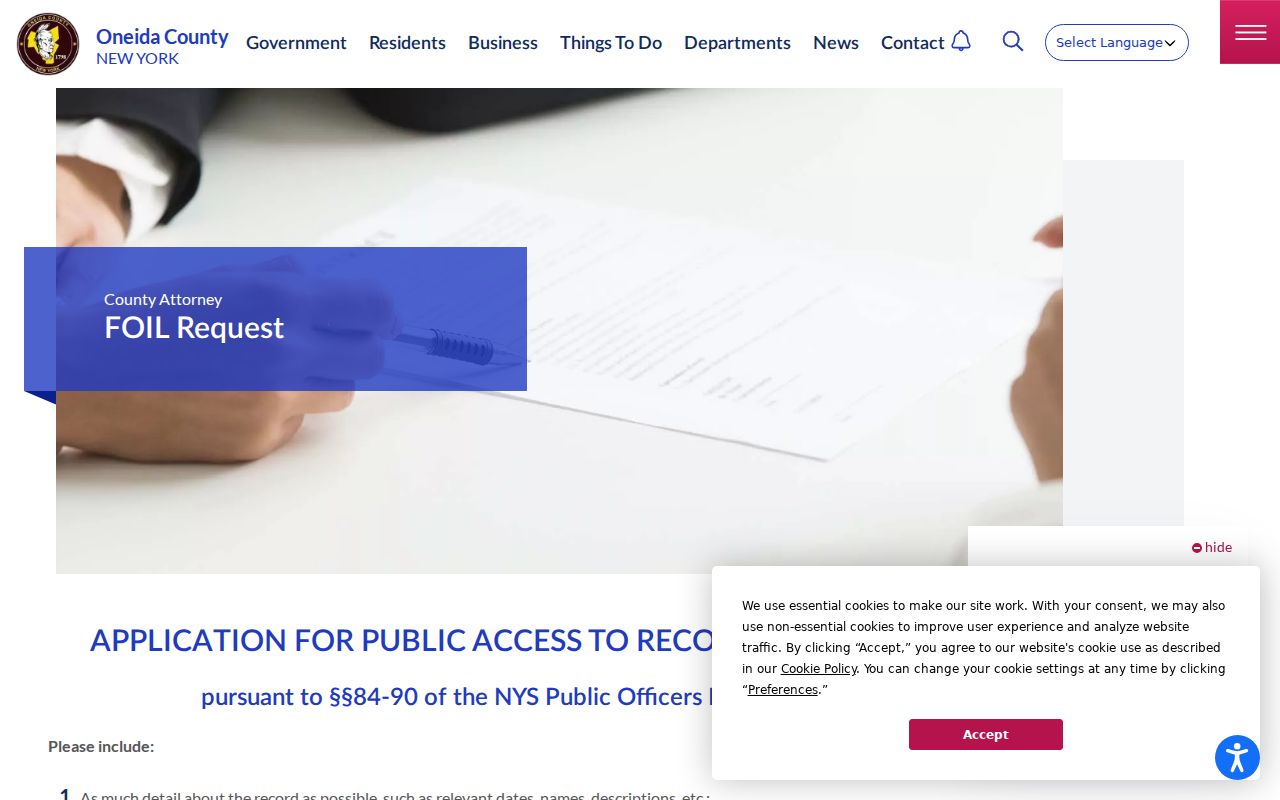
A request should name the department, record type, date range, and inspection or copy preference instead of asking an agency to build a new directory.
Rome Records Keep Changing
Online coverage is still expanding. Since 2023, the County Clerk has worked to make more material available through SearchIQS, added a map scanner in 2024, and continued deed and map digitization. A result set should be checked again when an older parcel matters. The annual Rome tax roll is also a snapshot, while the assessor, GIS, voter, court, and license systems each run on their own update schedule.
Keep an access date beside every result. It distinguishes a fixed directory edition or tax roll from a live search surface, and it makes a future comparison possible. Rome residents directory research is strongest when it preserves the record type, custodian, date, and limits instead of treating every online hit as the same kind of evidence. That simple habit also makes an older result easier to revisit.