
Rome Resident Lookup Record Paths
A Rome resident lookup is not one search. Rome City Clerk records, Oneida County land and civil-record indexes, State court tools, vital-record custodians, voter tools, and professional verification each answer a different, limited question. The city and county split is important: the City Clerk maintains city records and local vital registrations, while the Oneida County Clerk keeps recorded land and many county record series in Utica. Start with the record that matches the fact, then preserve the search date and custodian instead of merging similar names into one conclusion.
| Record | What it can confirm | Where | Access |
|---|---|---|---|
| Recorded deed or related filing | A recorded party and transaction | Oneida County SearchIQS | Guest index; image coverage varies |
| Civil case | A returned civil case identifier or filing path | NYSCEF Case Search | Guest search; not every case is online |
| Rome vital event | The proper local registrar route | Rome City Clerk or NYSDOH | Eligibility and request type control access |
| Voter status | A registered voter’s own status or poll-site information | New York Voter Lookup | Narrow civic purpose |
| Professional credential | License status and profession details | NYS Office of the Professions | Public verification, not residence proof |
A dated address can point toward a property or deed record. A case number belongs with the court search. An event place and date direct a vital request. Begin with the smallest question that the official record can answer.
Rome and Oneida Name Records
For a recorded land or filing question, the SearchIQS portal is the County Clerk’s online starting point. Enter the last name first without punctuation. Try spelling variants, initials, and a wildcard when the name is uncertain. Use Date From and Date Thru plus a document group to reduce unrelated results. Town is optional because not every document is indexed to town. Deed index and data coverage begins in 1963, while images normally begin in 1974. An index hit without an image is still a lead, not proof that no recorded document exists.
| Last name first | Use the County portal’s name order without punctuation. |
|---|---|
| Wildcard or variant | Tests initials and uncertain spelling without assuming two names are the same person. |
| Date range | Limits results to the period supported by the record question. |
| Document group | Separates deeds, mortgages, maps, liens, judgments, DBAs, or civil records. |
| Image indicator | Signals whether a document image may be available with the returned record. |
For older or thin coverage, search free on the County Clerk’s public computers and archival books. A mailed search request costs $5 for each two years searched after payment, so give the name, record group, date range, and any known parcel or instrument reference. That fallback is more accurate than treating a blank online result as a blank record history.
Rome Civil Case Lookup
NYSCEF Case Search permits guest searching by Case Identifier or Name, with county, case type, and filing-date limits available for narrowing a civil search. When both filing dates are used, enter them in mm/dd/yyyy form. A returned docket identifies a case path, not every document or outcome. Oneida’s mandatory e-filing history for many Supreme Civil matters begins in 2016, so older records may be paper files, held in a different index, or available from a clerk.
WebCriminal has a different role. It supplies selected future-appearance information, not a complete criminal history. For a Rome City Court matter, use the court clerk when the portal does not cover the court or record series. Sealed and confidential matters can remain unavailable even when a name search is otherwise valid.
Rome City Clerk Records
For a birth, death, or marriage that occurred in Rome, the local route is the Rome City Clerk, not the Oneida County Clerk. City-held vital and genealogical records begin in 1882. The City Clerk is also the custodian for city proceedings, licenses, and other city documents. An event elsewhere in Oneida County should be directed to the city or town where it occurred, or to the State route. A county mailing address or a hospital name alone may not identify the registrar.
The Rome City Clerk’s official page identifies the local records and vital-record route.
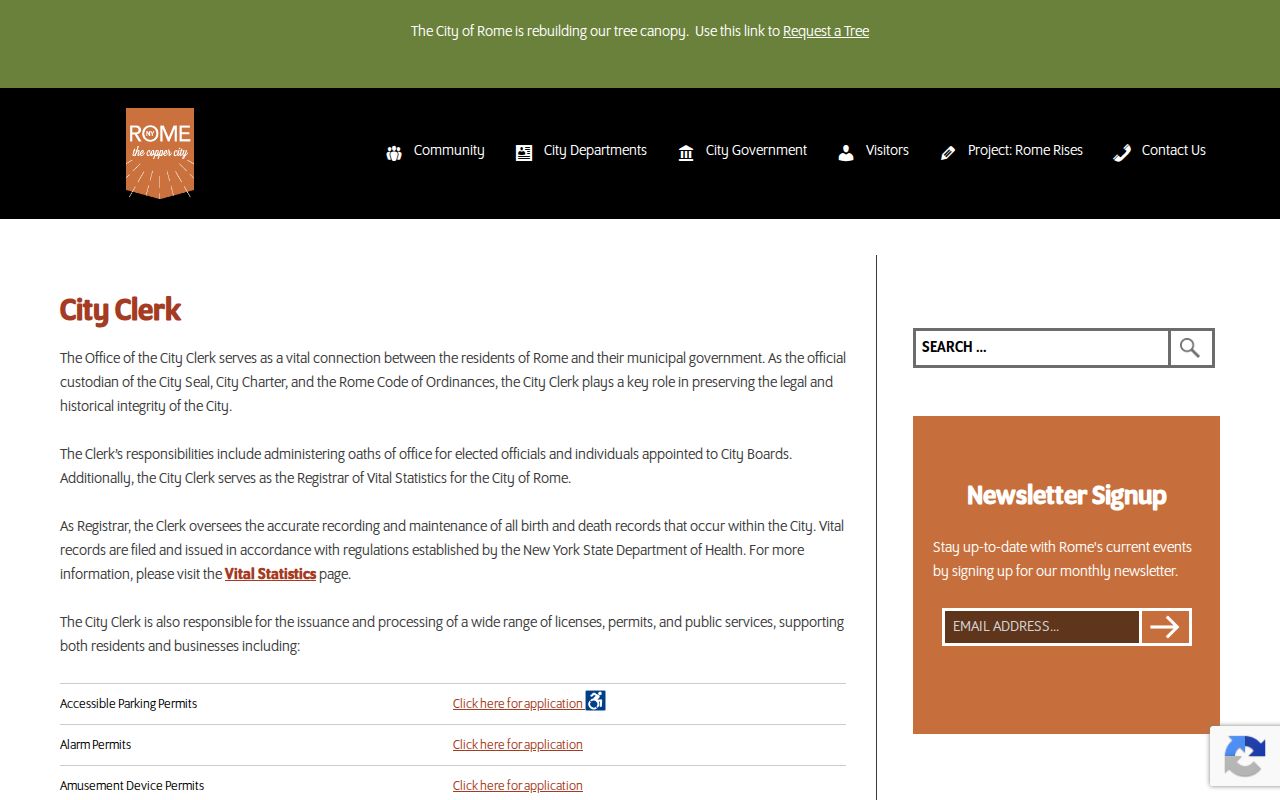
Use the event place, event date, record type, and whether a certified or genealogical copy is needed when contacting the Clerk. A dated request keeps the search tied to the correct custodian.
Rome Genealogy Record Dates
New York’s genealogy rules are different from certified-copy rules. Birth records become available after 75 years when the person is known deceased. Marriage records become available after 50 years when both spouses are known deceased, and death records after 50 years. A direct-line descendant may qualify sooner with the necessary relationship and death proof. The State’s genealogy route has its own search-fee schedule and can take eight months or more. Rome’s local registrar may be a faster option for a specific local certificate, but its current process should be confirmed first.
The New York vital-record genealogy guidance shows the public-year thresholds, direct-line exception, and request framework.
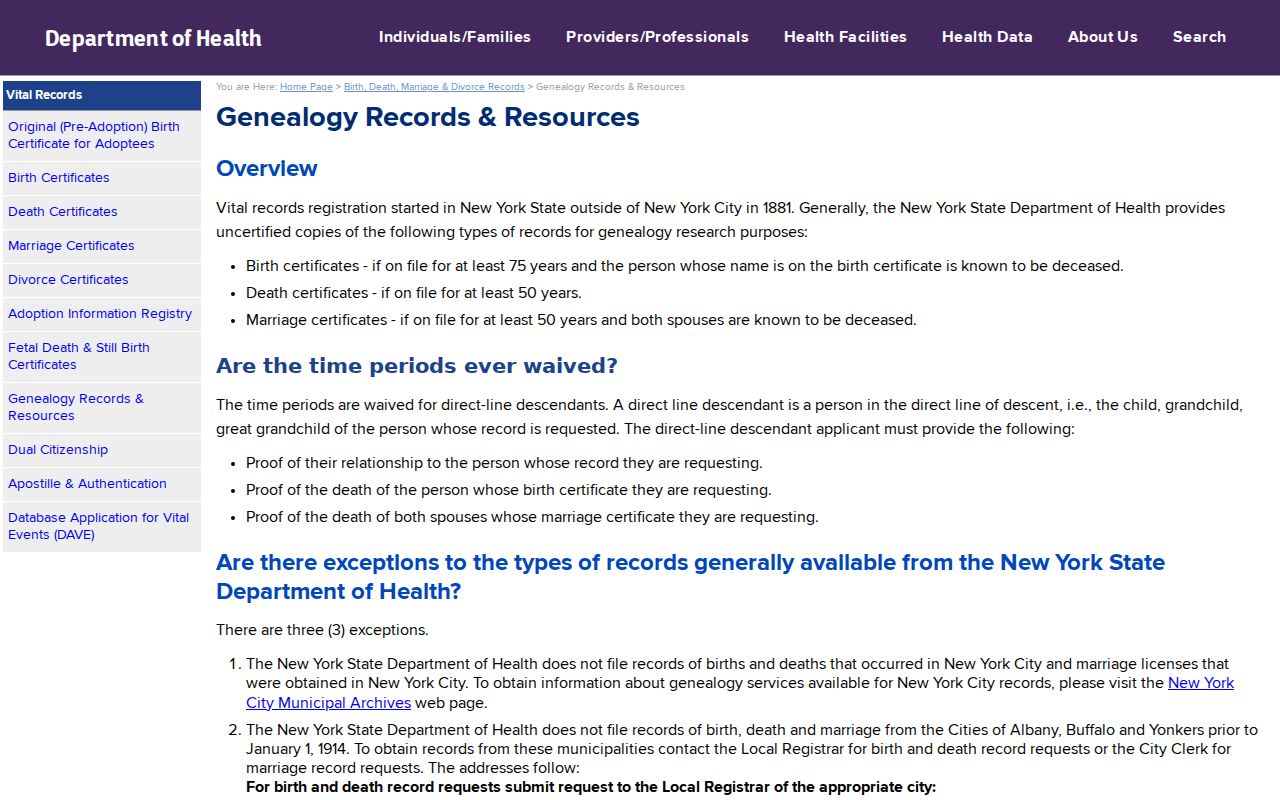
The access table applies to record age, death status, relationship, and request type. It should not be read as a general authorization to obtain any person’s certificate.
Rome Birth Record Eligibility
Certified copies use a narrower route. New York Public Health Law §4174 governs Department of Health birth and death certification access. Birth guidance identifies the named person and parent as the principal requesters, while other access usually requires a qualifying relationship or court order. A certified death record also has defined relationship, legal-claim, medical-need, or court-order routes. Marriage access is governed by Domestic Relations Law §20, and Public Health Law §4139 addresses certificates of dissolution filed with the Department.
The New York birth-record eligibility guidance illustrates the separate certified-copy process.
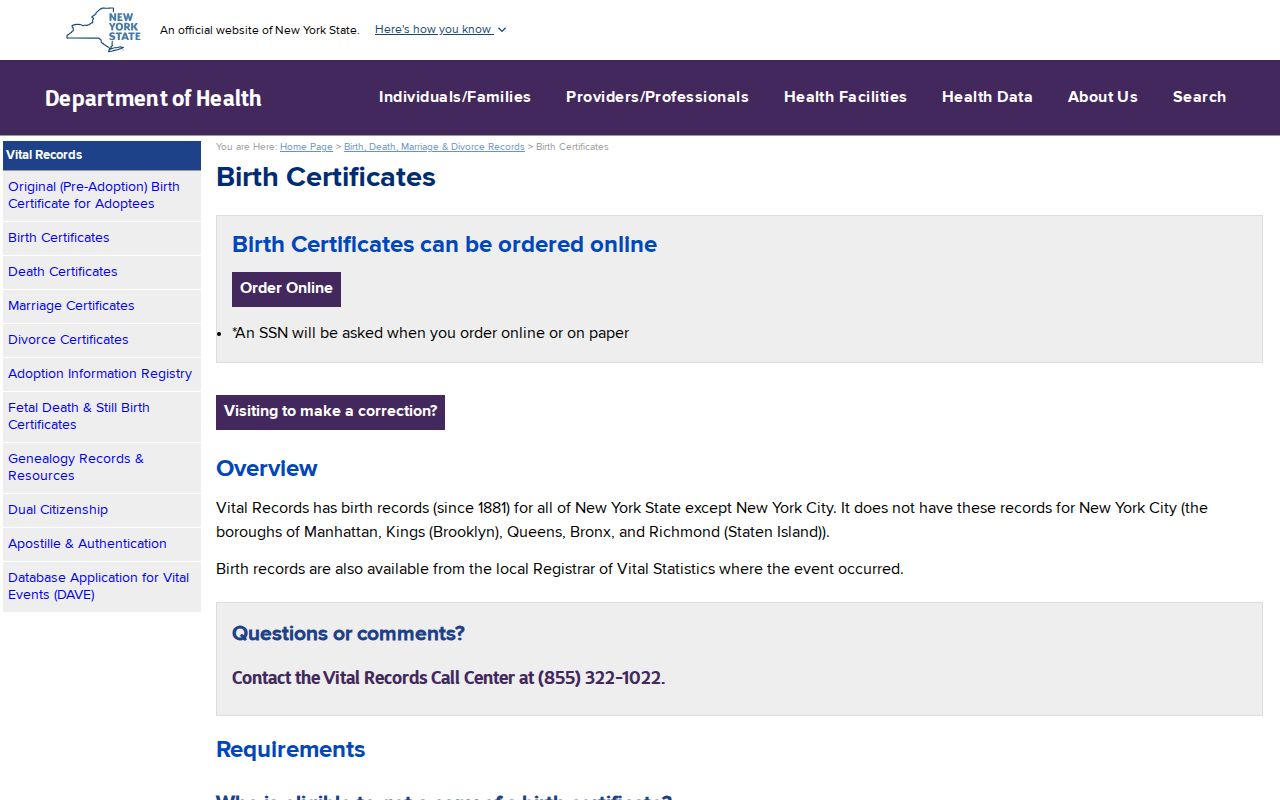
Certification status matters. A genealogical copy may be non-certified and marked for genealogical purposes only, while a certified copy has its own identity and eligibility requirements.
Rome Vital Indexes and Copies
The New York State Archives is an index and guidance source, not the holder of every vital certificate. Its material describes statewide registration beginning around 1880-81, incomplete early years, and microfiche indexes that can supply a name, date, location, and certificate number. The actual certificate remains with the appropriate local registrar or the State Department of Health under the applicable access rule. An index can narrow a request, but it does not prove the event or replace the certificate route.
The New York State Archives vital-record research guide explains the boundary between index research and certificate custody.
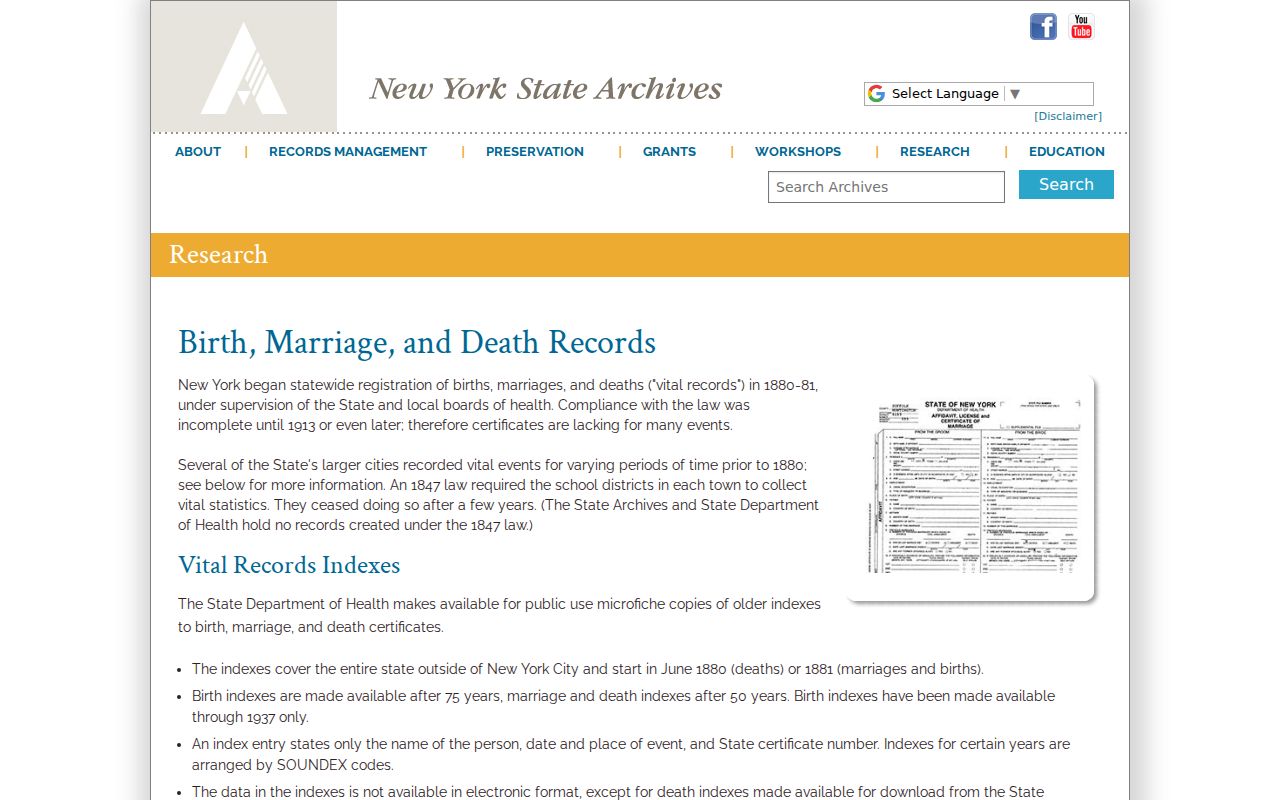
For a negative result, record the years, spelling variants, locality, and index consulted. “Not located in the reviewed index” is more accurate than saying no event record exists.
Rome Voter Lookup Is Limited
New York Voter Lookup is designed for a registered voter’s own registration and poll-site information. It uses last name, first name, date of birth, county, and ZIP Code, and may require browser support or CAPTCHA. It is not a public Rome resident directory. Individual voter files require a written FOIL request plus an elections-purpose statement under Election Law §3-103(5).
For public election research, use Flateau VEDA instead. Beginning with elections on or after April 1, 2026, it provides aggregate results, poll sites, maps, and participation statistics while excluding individual voter records. A confidential voter-registration statement can also keep an actual address out of the public file.
Rome License Results Need Context
The NYS Office of the Professions verification search can check a professional credential. Search one profession at a time with at least three surname letters, commonly entered as last name then first name without a comma, or use a six-digit license number. Results may show name, profession, license number, location, original license date, registration status, and discipline summaries. Try punctuation variants for a hyphenated or apostrophe name.
A credential result does not establish a current Rome residence. Treat the displayed location and status as dated verification information, not as a household or personal-address conclusion.
Rome Resident Lookup Verification Steps
Verification works best as a short chain. Use a dated official source to anchor one fact, then choose a second source that answers a different question. Avoid using one name result to fill in every unknown field. A record may name a person because of a transaction, a filing, an event, or a civic function without establishing present residence.
- Write the exact name, spelling variants, known date, and the limited fact to be checked.
- For a recorded transaction, run SearchIQS by last name first and restrict the document group and date range.
- For a civil matter, use NYSCEF with the county, case type, and dates or a full case identifier when known.
- For a Rome birth, death, or marriage, confirm the event place and request type with the City Clerk or State custodian.
- Keep the record date, access date, returned identifier, and any uncertainty instead of adding unneeded private details.
Do not use custody or registry material as part of a routine resident lookup. Those systems have separate purposes, update schedules, and legal limits, and a blank or partial result cannot identify a person or prove that no record exists.
Rome Record Terms Explained
Knowing the record type prevents a search result from saying more than it does. These terms are especially useful when a Rome name appears in both a county index and a court or vital-record search.
- Docket
- A case index or sequence of case events. It identifies a court matter but is not necessarily the filed document or outcome.
- Index and image
- An index points to a record. An image is the visible scanned document when the custodian makes one available. An index-only result may still require a counter or copy request.
- Certified copy
- A copy issued through the authorized custodian process. Eligibility, identification, and relationship rules can apply.
- Disposition
- The court’s outcome. It can require a separate request even if an online docket is visible.
Rome FOIL and Privacy Limits
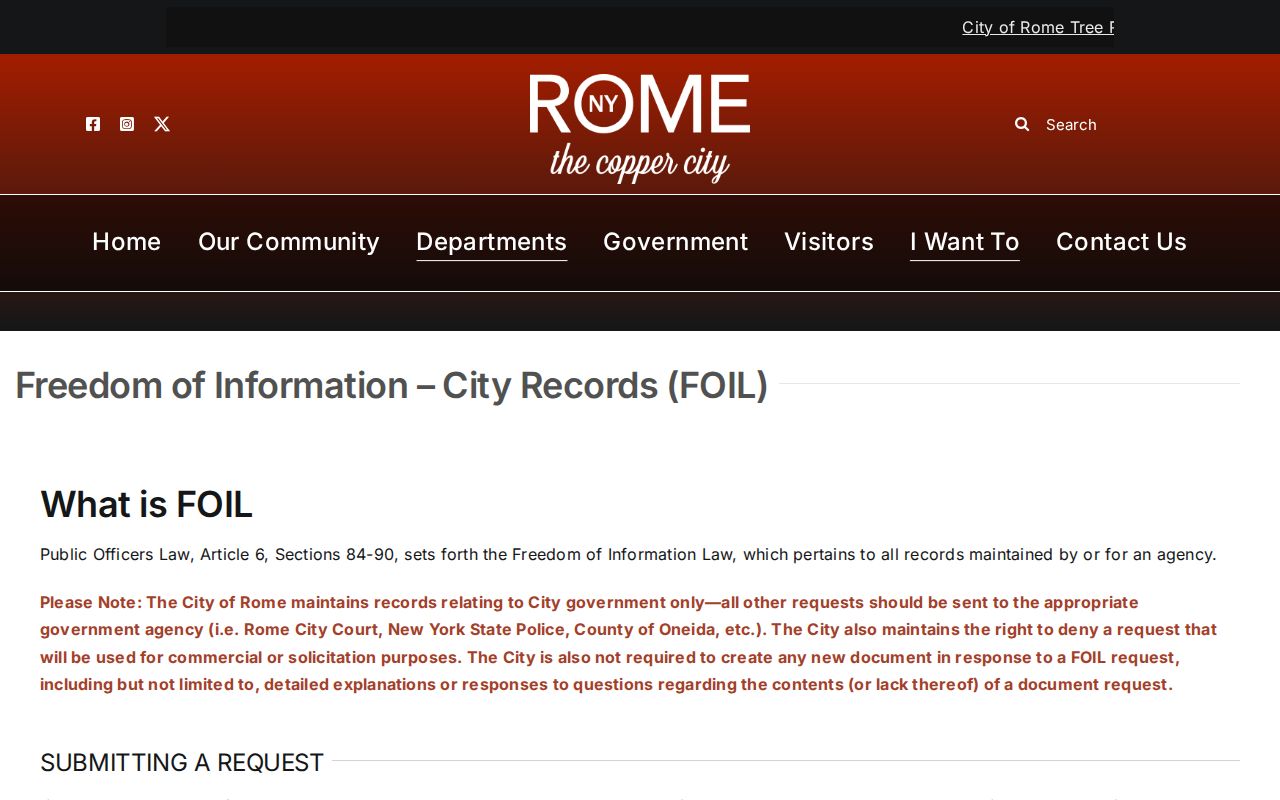
When no online index exists, ask the City of Rome for an existing city record through FOIL with a focused record type and date range. The City does not have to create a new list or answer a broad question by assembling records. New York agencies must acknowledge or grant or deny a request within five business days, or provide a date certain when more time is needed. The City may deny a request intended for commercial or solicitation use and may charge for extensive review or redaction.
The Rome City FOIL request page shows the City’s public request route and its choice between copies and inspection.
A focused request is more likely to reach a responsive record than an open-ended request for a person’s information.
The Address Confidentiality Program provides a substitute address for eligible people facing qualifying safety threats, and confidential voter registration keeps an actual residence out of public voter records. Sealed court, vital, adoption, Family Court, and matrimonial records also have separate limits. Leave a substitute address as shown. Do not combine public fragments to discover a protected location.
Lawful personal use. Use a Rome resident lookup for a specific, legitimate record question, such as family history, an official filing, or an estate matter. Do not use a similar-name result to stalk, harass, intimidate, or expose a private person.
Note: Verify a match with the custodian and retain only the minimum information needed to identify the record and its date.