
Rome City Directory Holdings
Rome has no single, continuous city directory run. Its confirmed shelf is spread among the New York State Library, a digitized volume, local-history collections, newspapers, and a research library. The State Library is the dependable starting point because it identifies the format as well as the title. A volume labeled Rome may instead cover a larger Utica and Rome area, while a business directory may list a proprietor without supplying a household. Keep the title, edition year, coverage geography, holding institution, and page or reel reference with every transcription.
| Collection | Years | Where held | Access |
|---|---|---|---|
| Rome directory listings | 1857/58 and 1859/60 | New York State Library | Fiche |
| Rome directory listing | 1866/67 | New York State Library | Film |
| Utica/Rome Area directory | 1871/72 | New York State Library | Film; broader geography |
| Rome, New York Directories | 1934 | Google Books scan from NYPL material | Online page images |
These holdings establish a baseline, not a promise of every annual issue. Ask for the exact year and format before arranging a reader or an interlibrary request. When a year is absent, record it as a gap rather than assuming the household left Rome.
See the New York State Library’s Rome city-directory holdings before requesting a fiche or film title.
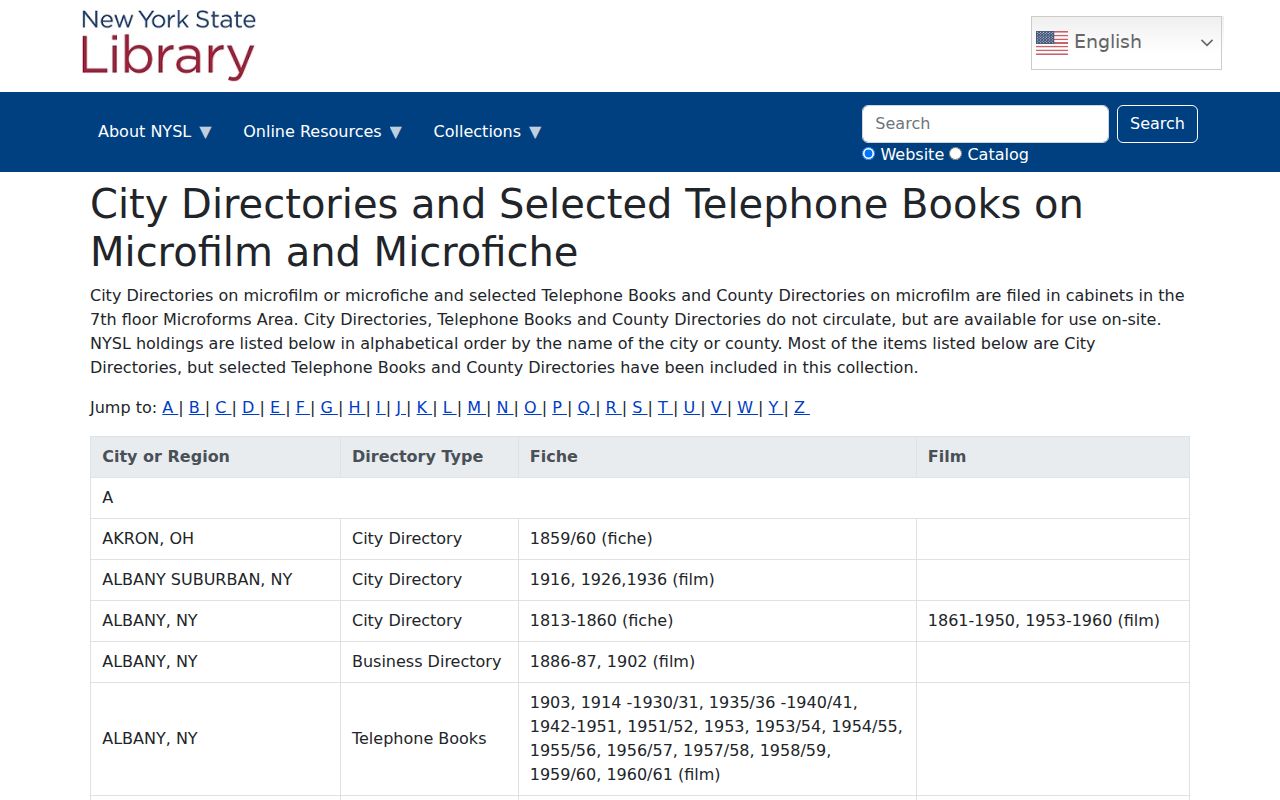
The holdings screen is useful for selecting a title and format. It does not turn the catalog entry into a searchable list of every name inside a volume.
Rome’s 1934 Directory Scan
The 1934 digitized Rome volume is a practical way to learn the printed entry style before ordering older material. Its OCR exposes personal listings and street entries, but OCR is only a computer reading of a page. It can confuse initials, names, house numbers, and abbreviations. Search a surname in more than one form, then open the page image and compare the printed name, street, and notation. A single hit says that the person was listed at publication time. It does not establish ownership, a continuing residence, or a current address.
The Google Books 1934 Rome directory scan shows the digitized source used for this type of page-image check.
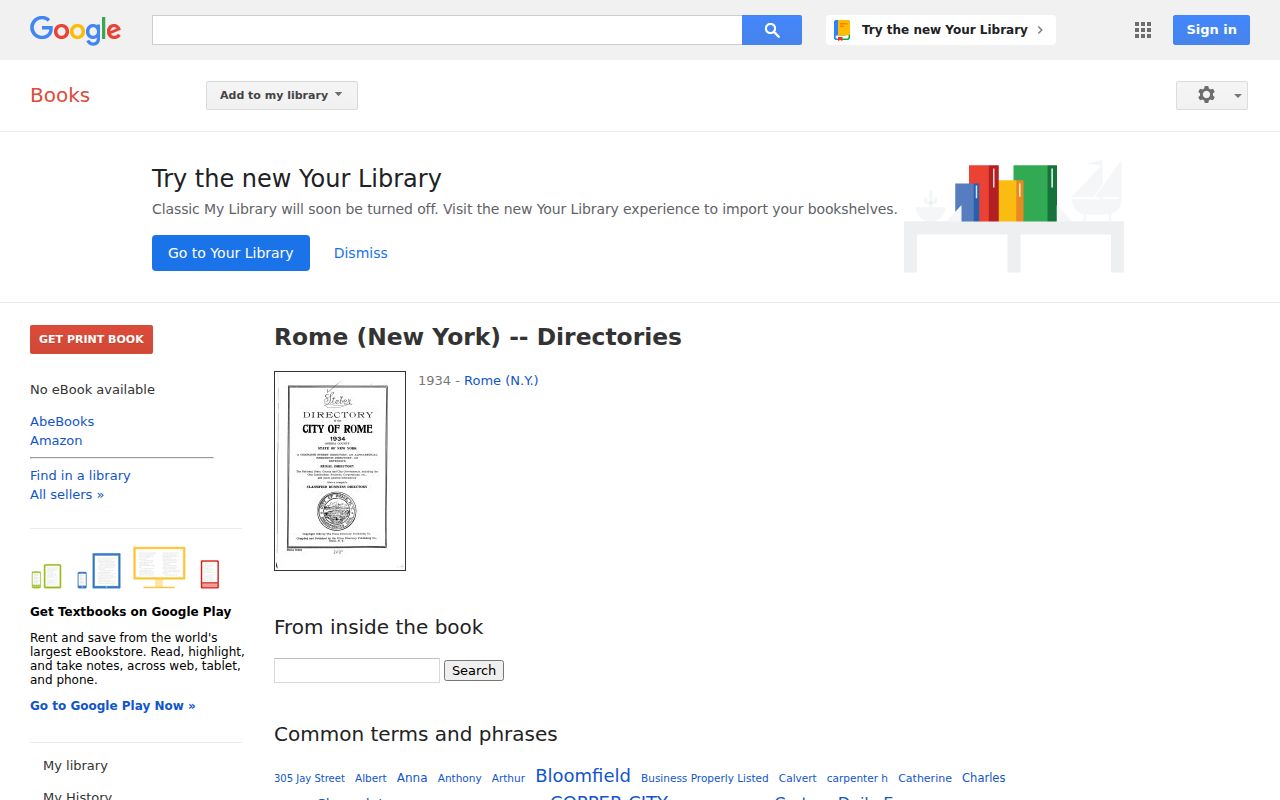
Use the scan to preserve a page citation and spelling exactly as printed. Then compare it with another dated Rome source before drawing a family or address conclusion.
Reading Rome City Directory Notations
A Rome city directory entry is compact. The 1934 scan can show a personal name, street and number, household shorthand, and an occupation or employer notation. Some lines use wid for a widowed relationship, emp for an employer-related notation, and h as a home marker. Read those marks from the actual volume, not from a modern guess. Their meaning is useful only with the entry’s date, the publisher’s printed key if present, and the rest of the page.
| Printed name | The spelling or initials used in that edition. |
|---|---|
| Street and number | A listed location at the directory’s publication time. |
| wid | A widowed-relationship shorthand printed with the name. |
| emp or role term | An abbreviated employer or occupation clue, not a current-status claim. |
| h | A home marker seen in some scanned listings; confirm it in the volume. |
- OCR
- Optical character recognition, the machine text extracted from a scanned page. It is a finding aid, not a final transcription.
- Criss-cross format
- A directory arranged by street rather than surname. The official Rome sources reviewed do not confirm a complete local run, so verify its presence for a particular volume.
- Page-image check
- Reading the visible scan to confirm a name, number, and abbreviation that OCR may have misread.
Tracing Rome Directory Households
Start with the directory year nearest the known event. Copy the whole line, including punctuation and abbreviated terms. Move one available edition backward or forward at a time, rather than jumping from a nineteenth-century listing to a modern record. A name that disappears may reflect a skipped publication, a surname variant, a new address, a boarding arrangement, an OCR miss, or a volume with limited coverage. It does not by itself prove a move or death.
A carefully dated city directory point becomes more useful when the source role is kept clear. It can show a printed listing near an event, while a census, deed, tax roll, or newspaper contributes a separate date and kind of evidence.
- Choose a State Library year or the 1934 scan closest to the person or address.
- Transcribe the name, street spelling, house number, household notation, and any role term exactly.
- Compare the next available directory year for a changed spelling or address.
- Pair a directory point with the surrounding decennial census years, such as 1934 between 1930 and 1940, to test the household.
- Use a newspaper, yearbook, cemetery resource, tax roll, or deed only for the question that source can answer.
For a historic address, retain the printed address separately from a modern parcel or postal form. Rome has no official street-renumbering schedule identified in the research, so an apparent match needs a map, legal description, city record, or consecutive listings to support it.
Rome Directory Leads at Jervis
Jervis Public Library, at 613 N. Washington Street, can be reached at (315) 336-4570 and is the local place to extend a directory lead without pretending that every resource is a directory. Its local-history material links People in Rome, cemetery resources, the Reid Gallery of Prominent Rome Citizens, Revolutionary War rolls, historical maps, and Sanborn maps. Rome Free Academy yearbooks run from 1902 through 2020, with documented gaps for 1909 and 1910. The marriage-license index is incomplete. Those limits matter when a name appears in one collection and not another.
The Jervis Public Library local-history collection is the source for these Rome research leads.
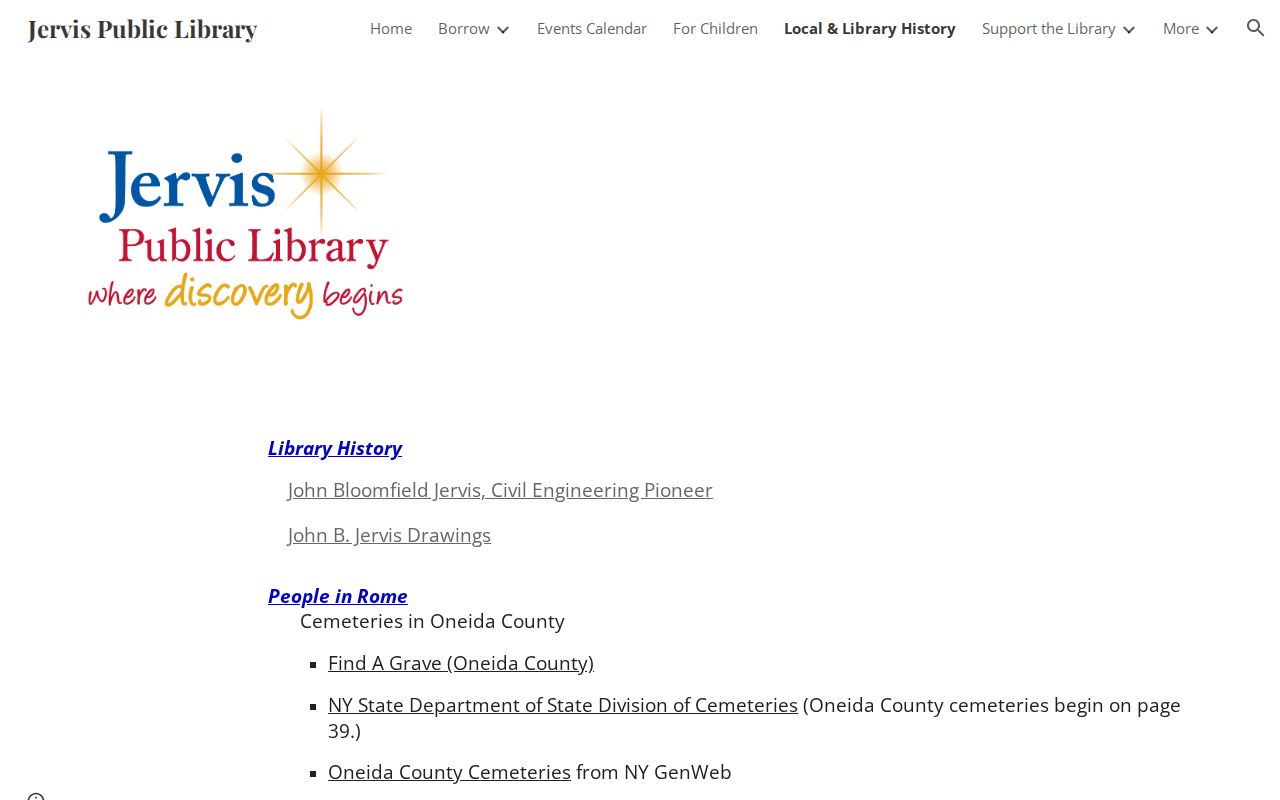
Ask the reference desk whether a particular item is an index, a digitized image, or an on-site file. The official page does not establish a complete local directory, obituary, telephone-book, or reverse-directory run.
Rome Directory Newspapers and Gaps
Newspapers can test a directory clue when an issue date or event is known. The State Library’s Oneida guide identifies the Rome Daily Sentinel, Roman Citizen, and Rome Citizen with detailed microfilm coverage and gaps. A name, street spelling, business notice, marriage announcement, civic appointment, or obituary can help date a listing. It still needs a title, issue date, and page in the research note. A missing issue is not proof that nothing happened.
Consult the New York State Library’s Oneida newspaper holdings to identify the exact newspaper run before requesting film.
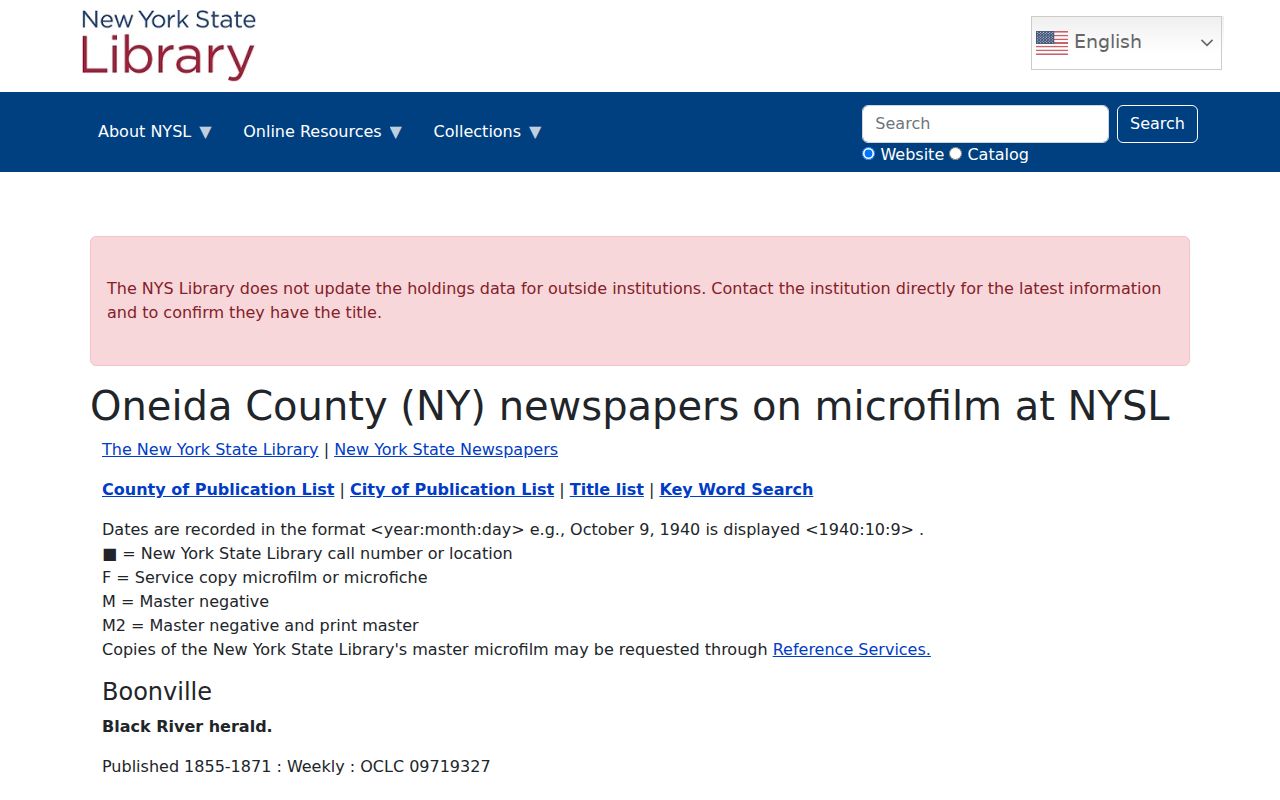
The listing helps locate the right reel and title. It also makes the documented discontinuities visible, which is essential when a directory trail has a gap.
Note: Preserve the newspaper title and issue date with a directory comparison, because Rome publications changed names and have incomplete runs.
Rome Historical Society Research
The Rome Historical Society adds collection context that a printed city directory cannot supply. Its research library at 200 Church Street, (315) 336-5870, holds more than 10,000 archived books, documents, photographs, and paper records within a collection of more than 40,000 objects. The Society covers Rome, Fort Stanwix, the Erie Canal, the copper industry, and Griffiss. A directory clue about a business, street, or family can be a useful starting point for a collection-level request, not a reason to ask for a bulk name list.
The Rome Historical Society collection page describes the research-library setting and request route.

Visits should be scheduled and research fees may apply. Give the Society the title, year, name variant, and address or subject already supported by a directory citation.
Rome Maps, Geography, and Directories
Directory geography needs care. Rome is the target city, yet the County Clerk and county-seat records counter are in Utica. A directory may cover Rome alone, Rome with Utica, or a wider business area. A later tax roll, deed, GIS layer, or USPS record can describe the same place with a different geographic label. Do not normalize an old street number to a current address unless the connection is supported.
The Library of Congress 1909 Rome Sanborn set has 34 sheets for testing a building footprint or historic street layout. A map can support location and use, but it is not a resident roster and cannot establish that a named person occupied the structure.
Rome Records After the 1848 Fire
Early gaps have a local explanation. The Rome courthouse and jail were destroyed by fire in March 1848 after a new courthouse had opened the previous year. A replacement courthouse opened in 1851. That loss does not prove that every early record vanished, but it is a reason to avoid inventing a smooth paper trail. Surviving directories, newspapers, deeds, naturalization records, family papers, and archival descriptions may each carry part of the answer.
| 1848 | Rome courthouse and jail destroyed by fire. |
|---|---|
| 1851 | Replacement courthouse opened. |
| 1857/58 | First verified Rome directory holding in the State Library baseline. |
| 1909 | Rome Sanborn map set provides 34 sheets of built-environment context. |
| 1934 | Digitized Rome directory volume offers a readable entry example. |
Checking a Rome Directory Match
Use at least one independent Rome source before connecting a directory line to a person or place. A deed identifies grantor and grantee in a recorded transaction. A tax roll supplies owner and address fields for one roll year. A newspaper can date an event. A yearbook, cemetery source, or archive file may establish a different connection. Each source answers a narrower question than a modern identity profile would suggest.
When an older land or court record is not available online, the Oneida County Clerk’s records-search route offers an in-person or mailed fallback. Keep the result type separate from the directory transcription. A careful Rome city directory result can be repeated by another researcher because it preserves the edition, page, source, date, and uncertainty.